
Mayor launches further action to improve air quality as figures show a fall in pollution
Published: Wednesday 18 Nov 2026
Every child in the West Midlands is to get practical advice on how to improve air quality where they live thanks to one of the country’s first region-wide air quality education programmes.
Richard Parker, Mayor of the West Midlands, launched the Air Quality Toolkit at Windy Arbor School in Chelmsley Wood, Solihull today as latest figures gave the clearest indication yet that sustained action to tackle air pollution is starting pay off.
New analysis of the latest air quality data by the West Midlands Combined Authority (WMCA) reveals levels of harmful nitrogen dioxide (NO₂) are steadily falling across all seven local council areas, with average reductions of between 20 per cent and 40 per cent.
The improving picture is down, in part, to better monitoring and continued investment by the Mayor in cleaner public transport as well as more motorists switching to electric vehicles.
Other direct action by local councils is also having a major positive effect, including diverting older and more polluting cars away from roads with the dirtiest air.
To further raise public awareness of the issue a new series of practical guides and fun activities developed by the WMCA, in partnership with PWLC Projects, will be freely available to schools from today as part of a wider programme of action.
The Air Quality Toolkit will show children how to protect their health by recognising sources of pollution and the simple changes they can make to their daily routines, while encouraging others to take action.
The resources are endorsed by health and environment specialists. They have been designed for schools, but can be downloaded by anyone from the Clean Air West Midlands website.
The Mayor said: “Clean air is a right, not a luxury - it's as simple as that. The children at Windy Arbor School are the first to use our new toolkit, and it was fantastic to see them getting stuck in to understand why tackling pollution matters and how they can play their part.
“There’s no safe level of air pollution, it’s one of the biggest environmental risks to our health. We are making good progress in getting harmful levels down, but we will not take it for granted. I am as focused as ever on my ambition for everyone, wherever they live, to be able to breathe easier, and for children to get the best and healthiest start in life.”
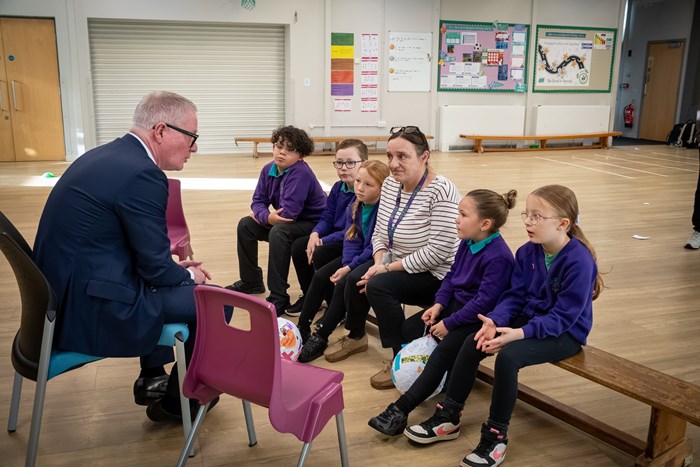
Richard Parker, Mayor of the West Midlands, with pupils from Windy Arbor School about their experiences of living with asthma at the launch of the new Air Quality Toolkit.
During the Mayor’s visit to Windy Arbor Primary School he spoke to pupils and their teachers about how asthma and other respiratory conditions are affecting their own lives.
Joanna Curry, headteacher at Windy Arbor School, said: “Our school was proud to host the launch of the West Midlands Air Quality Toolkit, welcoming Richard Parker, Mayor of the West Midlands, to meet our school community. As the first to use the new resources, our children explored the importance of clean air, learning about the impact of pollution on health and the simple actions they can take to make a difference.
“We are delighted to have played a leading role in launching this important programme, which will now be rolled out to schools across the West Midlands, helping children develop the knowledge and confidence to improve air quality for future generations to come.”
Currently around 1,700 people with conditions such as asthma, heart disease, stroke and lung cancer die early every year due to long term exposure to air pollution, according to the latest modelling by the University of Birmingham.
Reducing this figure and improving quality of life for all three million West Midlands residents is at the centre of the WMCA’s first Air Quality Framework.
The framework includes a series of measures that can accelerate improvements to air quality on a regional scale with a focus on reducing high levels of harmful microscopic particles in the air, known as PM2.5 and PM10, that come from things like wood-burners, factories and tyre dust.
Last year the Mayor launched one of the UK’s most advanced regional air quality monitoring networks with 90 sensors.
They are now providing more detailed data than ever, helping to pinpoint pollution hotspots. The data is also helping to guide action to reduce exposure to harmful pollutants with the monitors linked to a website showing near real-time pollution levels and a live alerts system when levels spike.
The sensor network is part of a package of measures funded by the Mayor over the last two years. They include:
- The roll out of hundreds more electric buses
Extending the Metro further into Birmingham and the Black Country - A fast-growing network of publicly accessible electric vehicle chargers
- £155,000 community grants to support locally led environment projects
- Awareness campaigns and citizen science projects to make daily routines and working practices cleaner and greener
- Copies of Aunty Duck air quality story book made available to all primary schools The launch of a Local Nature Recovery Strategy alongside one of the first regional nature fundraising platforms
An updated air quality action plan is expected to be published by the WMCA early next year with new standards on PM2.5 particulates, and nitrogen dioxide (NO2) levels that are more ambitious than those currently set at national and international level.
Viv Marsh, clinical lead for children and young people with asthma for Black Country Integrated Care Board, said: “Helping children and families understand the link between air quality and health is essential, and this toolkit is an excellent place to start. As a children's asthma nurse, I see first-hand how poor air quality can affect developing lungs and make life more difficult for children living with respiratory conditions. By learning more about the issue and taking simple steps to reduce pollution, we can all contribute to creating healthier environments for our children to grow up in.”
Dr Suzanne Bartington, clinical associate professor in environmental health at the University of Birmingham, said: “Air quality is improving in the West Midlands but many people still experience harmful levels. Enabling people to see the quality of air they are breathing, empowers them to take practical steps to reduce exposure and improve health.”
Further enquiries
For all other enquiries from members of the public go to our contact us page: https://www.wmca.org.uk/contact-us/